Showing posts with label musical cartoons. Show all posts

Thursday, October 16, 2025

Have You Got Any Castles? (Black Woollcott)


Director(s): Frank Tashlin

Summary: The second of Frank Tashlin’s “Midnight in the Bookstore” shorts (first is “Speaking of the Weather,” which I covered before, and the third is “You’re An Education”). This one is introduced by Alex Woollcott, includes The Three Musketeers breaking The Prisoner of Zenda out of jail, and Rip Van Winkle shutting down the latest après-minuit literary party because he needs his sleep (why? He’s had 100 years’ worth).

Compared to “Speaking of the Weather,” this is a bit heavier on the racial/ethnic caricatures of years past, but “You’re An Education” wins at the end of the day. Despite that, this short (and the other two)  did make its rounds on American TV and did appear on home media, as mentioned below.

The Channel(s): Blue Ribbon Merrie Melodie reissue version, TBS, Cartoon Network, and unnamed syndication (local affiliate stations).

Part(s) Edited: Before I get in on the edits done to remove racial/ethnic stereotypes, I’d like to start with the edits done on the Blue Ribbon Merrie Melodie reissue, which also applies to the syndicated versions and the versions shown on TBS and Cartoon Network.

Alex Woollcott (who was caricatured before on Tashlin’s “The Woods Are Full of Cuckoos”) did not like his caricature in this short, so he requested it to be cut when the short was reissued to theaters (which, coincidentally, happened after he died). This decision affected only two scenes in this short: the beginning where Woollcott introduces the literary performance and the end when he closes out the short, and the cuckoo bird is muffled while Rip Van Winkle continues to sleep (that scene was an innocent bystander that got removed because the Alex Woollcott scenes got deleted). The reissued version was the version that aired on television (when it did air on television), including TBS and Cartoon Network.

In addition to the appearances of Alex Woollcott, TBS’ version also cut Bill “Bojangles” Robinson tap dancing up and down the cover of The 39 Steps, the “Swing for Sale” part that was recycled from the Censored Eleven cartoon “Clean Pastures,” and both scenes of Rip Van Winkle cutting Uncle Tom’s hair to use as earplugs during the performance of the title song (with Uncle Tom punching Rip Van Winkle in the face several times and cutting his beard the second time).

If you can believe it, Cartoon Network actually aired this cartoon during their weekday morning installment show, The Acme Hour (which is a collection of Warner Bros., MGM, and Fleischer shorts with the intro, outro, and commercial bumpers showing what it’s like to be on the business end of classic cartoon slapstick, like getting hit in the face with a plank, falling off a cliff, having a piano drop on your head, wearing rocket-powered roller skates, covering a house with invisible paint, flooding a living room after using an ACME brand glass cutter on an aquarium, etc) and aired a version where the only edits made were to the bookend scenes with Woollcott, as well as the final image where Rip Van Winkle is asleep on the cuckoo clock after tying the bird’s beak shut, making this the closest that a Censored Eleven cartoon has come to airing on television in the United States because the “Clean Pastures” part with Cab Calloway singing “Swing for Sale” wasnt censored. The short eventually got phased out and replaced with other cartoons, so, you know, pyrrhic victory.

What Grinds My Gears About the Edit: It’s been a while, but we’re back with, “The edits are jarring, but since this is one of those thinly-plotted musical cartoons, it doesn’t affect anything else about it.” At least, when it comes to the “Clean Pastures”/“Swing for Sale” part that was edited on TBS. The reissue cuts will leave you wondering what was edited from the beginning and ending (though the ending cut is seamlessly done) and why if you’ve never seen this short before and know nothing of its history…then, when you find the reason, you’ll either still ask, “Why?” or just say, “Oh,” and carry on.

Video Comparison: You can tell that the Alex Woollcott scenes were supposed to be edited out because the newer version has film splice marks on it. The other cuts, well…let’s go to the video:

Availability Uncut: It’s on the Golden Age of Looney Tunes laser disc (volume 1, side 1: 1930s Musicals) and VHS (volume 1: 1930s Musicals), but it’s most likely the version that didn’t restore the Alex Woollcott scenes. Those scenes wouldn’t be restored until the Looney Tunes Golden Collection volume two DVD set. This also applies to volume two of the Looney Tunes Spotlight Collection (and all its repackaged versions, such as The Looney Tunes Collection All Stars, The Looney Tunes Spotlight Collection Double Feature [a repack of volumes two and three], and The Looney Tunes Spotlight Collection volumes 1-3 repack). It’s also a special feature on the DVD version of the movie Varsity Show, starring Dick Powell and Fred Waring, though I don’t know specifically if it’s the older version without Alex Woollcott or the newer version with him. The older version has become harder to find than the newer version, which is everywhere thanks to the short being in the public domain since 1967 and the relative ease in which one can upload the newer version on YouTube and let that proliferate (or go viral, in todays terms).

Is/Was It Available on Streaming?: No, it isn’t. That also applies to “Speaking of the Weather” (which I covered prior to the news that Tubi uploaded the Warner Bros shorts on their service) and “You’re An Education” (which I’m covering in a future special post about cartoons with scenes that have missing scenes long before television censors got their hands on them. It wasn’t edited for anything on the one time it aired on Cartoon Network, but it was replaced with another cartoon on a rerun of the animation history show, ToonHeads, for the episode “Midnight in the Bookstore”). This shouldn't worry you, though, because it's a public domain cartoon and it can be watched on YouTube or on the Golden Collection DVD.

As an added bonus, here’s the actual, uncut version of “Have You Got Any Castles?”, complete with outdated racial stereotypes and scenes featuring Alex Woollcott:


And a censored version shown on a former WB affiliate known as WB18 (I have no idea what state had that as a channel. The closest I could find is either WBG18 in Wheeling, West Virginia or WVTV18 in Milwaukee, Wisconsin):

This version just cut the “Bill Robinson tap dances up and down The 39 Steps” and the “Swing for Sale” part (in very much the same way I did on the approximation video, only they left in the part where The Invisible Man and Topper perform a tap-dance number. I just assumed it would be cut for continuity reasons, like the part where they show Greta Garbo on the cover of So Big in yet another joke about how she had big feet for a woman), as well as the Alex Woollcott scenes. The Rip Van Winkle/Uncle Tom parts weren’t censored.

‘Til next time…


Monday, August 4, 2025

September in the Rain (No Plot? Plenty of Problems!)


Director: Friz Freleng (credited as “I. Freleng”)

Summary: Your typical “midnight in the store” cartoon. This one is in a grocery store on a rainy night where the products and their label mascots come to life and do bits and musical numbers (some of which are recycled from other shorts, since Freleng did do that). It’s short, it’s sweet, it’s played straight, and while not that many people like it, I think it’s fine for what it is.

Fun Fact: This was submitted and screened for an Academy Award nomination, but was never picked. That...might be for the best, given how painfully average it is, but the rotoscoping on the Fred Astaire/Ginger Rogers dance is at least worth something.

The Channel(s): TBS, TNT, Cartoon Network, Boomerang, and on DVD.


Part(s) Edited: All the black caricatures are cut from this short, though the 1995 Turner dubbed version at least left in the Al Jolson “Dream of Wheat” (Cream of Wheat) mascot serenading the Aunt Emma (Aunt Jemima, now known as “Pearl Milling,” which yeah, does sound like the name of a U.S. Southern black woman and “Aunt Jemima” could have been her nickname when she became known for her pancakes or what her white slave owners called her) mascot with the title song. I’ve never seen that version; I’ve seen the version where every black caricature is cut and the cartoon, which already has a 5-minute, 47-second runtime, now runs at 3 minutes and 32 seconds (or 4 minutes and 36 seconds, if it’s the version where the Al Jolson/Aunt Emma part was left in, but not the performance of “Nagasaki” at the end).


What Grinds My Gears About the Edit: On the one hand, the cartoon was just a collection of musical numbers and light comedy bits, so complaining about how the edits ruined the cartoon is kinda stupid on my end (not as stupid as making an already short cartoon shorter, but that’s neither here nor there). On the other hand, it’s obvious that parts are cut because of the jump in music.


Video Comparison: Instead of doing one video showing the uncut vs. cut scenes, I’m showing the actual cartoon vs. the common edited version (Cartoon Network, Boomerang, TBS, TNT, and on DVD) and the 1995 Turner dubbed version (which probably aired on Cartoon Network, TBS, and TNT back in the 1990s, though it could have been made for unnamed syndication and some home media releases):


Uncut Version:


Edited Version #1 (version where all black caricatures are cut)


Edited Version #2 (version where the Al Jolson/Aunt Emma part is uncut, but the ending isn't):


Availability Uncut: Yeah, about the only place this is available uncut is The Golden Age of Looney Tunes laser disc (volume 4, side 10). The DVD version of the Fred Astaire/Ginger Rogers movie, Carefree, has an edited version, though I don’t know which one (the one where all the black caricatures are cut or the one where at least the Al Jolson/Aunt Emma scene was uncut). It hasn’t been on television since…I wanna say, the early 2000s (last seen on Cartoon Network) because, even with the parts cut, it’s just filler. Be glad that the uncut laser disc version can be found on sites like archive.org.


‘Til next time…


Saturday, July 5, 2025

Speaking of the Weather (An Old Buddy [Cartoon] of Mine)

Director: Frank Tashlin

Summary: A “midnight in the store” cartoon (the first of three that Tashlin did and his first color cartoon), featuring celebrity caricatures and spoofs of popular reading material of the day all set to the title track of the short. This one takes place at a drugstore after midnight, and the reading material shown are magazines of all types. Like all “midnight at the store” shorts, this one has a rather thin story to break up the monotony of the gags and music. This one has a yegg from The Gang Magazine trying to break into a safe shown on the cover of The Magazine of Wall Street and Business, only to have everyone from Boy Scouts from Boy’s Life magazine to Greta Garbo on the cover of Photoplay stopping him when the crook inevitably escapes from the prison cell on the cover of LIFE.

The Channel(s): Cartoon Network and Boomerang

Part(s) Edited: A light edit on this one. When the prisoner makes his escape and all the magazine characters go after him, all that was cut were two shots of the African natives running towards the camera, which, if you can believe it, is recycled footage from “Buddy of the Apes” (which definitely didn’t air on Cartoon Network due to the stereotypical depictions of African natives/non-white indigenous peoples) and “Buddy’s Theatre” (which also didn’t air on Cartoon Network for the same reason, though, now that I think of it, I don’t think Cartoon Network aired any Buddy cartoons because…they just weren’t that good. Not even Late Night Black and White showed them, to my knowledge, and they showed the few shorts that had Goopy Geer as a character).

What Grinds My Gears About the Edit: Not much, unless you count the second edit where you can clearly hear the angry natives over the shot of the thug bouncing on the spears thrown at him. Even then, I give that a pass, because audio cue mistakes happen a lot in editing and that mistake can easily be dismissed as the walla of off-screen magazine characters that somehow got spears from other magazine covers (possibly one about primitive weapons or touring African jungles).

Video Comparison:


Availability Uncut: “Speaking of the Weather” hit the home media release trifecta of the 1990s going into the early-to-mid 2000s: it was on the laser disc and VHS versions of the Golden Age of Looney Tunes series (volume 1, “1930s Musicals”) in 1991. Fourteen years later, it appeared on the third volume of the Looney Tunes Golden Collection (the volume where the concentric circles are black, Bugs is holding one of the singing girls from that short, and it comes with a warning about politically-incorrect content courtesy of Whoopi Goldberg) on the second disc, featuring Hollywood spoofs of the 1930s, ‘40s, and 50s. Three years after that, it appeared as a special feature on the DVD version of the movie, Gold Diggers of 1937, starring Dick Powell, Joan Blondell, Victor Moore, and Glenda Farrell, and that’s where it’s been ever since. As of this writing, it hasn’t been re-remastered for Blu-ray or put on streaming, which is a shame, because this feels like it could have been on HBO Max when that service first launched in 2020, only to be pulled because it had outdated racial and ethnic stereotypes in it.

‘Til next time…


Monday, March 3, 2025

I Love to Singa (Gogo Dancer)

Director: Fred “Tex” Avery

Summary: Another early Tex Avery cartoon that doesn’t feel in-character for him, but, unlike “Page Miss Glory,” Tex probably didn’t hate this one as much. This one is the story of an owl family that prides itself in classical music and opera, but are left reeling when one of their children is a jazz singer (back then, jazz was seen with the same disdain as rap and hiphop in the 1980s and 1990s: if you were white and into that, you were a disgrace to your family or a race traitor/poseur). When forcing the jazz singing son (named Owl Jolson) to sing opera doesn’t work, Owl gets thrown out and decides to make it on his own as a jazz singer. His first gig: a radio amateur hour, where anyone who doesn’t win over Jack Bunny (a very common pun name on comedian Jack Benny) gets rejected and ejected from the studio.

And if this short still isn’t familiar to you, the sound clip of Owl Jolson singing the title song was used on the very first episode of Comedy Central’s South Park ("Cartman Gets an Anal Probe") when Cartman is controlled by the anal probe and the cows use alien tech to make Officer Barbrady sing.

The Channel: TNT (on The Rudy and Gogo World Famous Cartoon Show)

Part(s) Edited: Two scenes were cut for time (as there wasn’t anything offensive about the two scenes cut):

1) After Owl Jolson is hatched and shocks his parents with his rendition of “I Love to Singa,” Fritz Owl decides that the best way to “cure” Owl’s jazz singing is to force him to sing “To Cilia,” which doesn’t work, as Owl keeps interjecting, “I Love to Singa” in between verses.

2) When Owl Jolson runs away from home, he happens upon Jack Bunny’s Amateur (spelled “Amatuer”) Radio Show, where contestants keep getting gonged and put through the trap door for bad performances.

How It Plays Edited/Video Comparison: The way I edited it on the video is probably not how it played out on The Rudy and Gogo World Famous Cartoon Show, but it’s one of those edits that Nickelodeon used to be able to do when it aired Looney Tunes cartoons: tried to salvage the cartoon and had a sense of humor about editing the shorts. If you remember Rudy and Gogo and how “I Love to Singa” was cut, then, by all means, describe it in the comments or email me. For now, enjoy the video:

Availability Uncut: This one is popular enough to be released on home media. I'm not going to list them all (a full list can be found here), but I am going to list the DVD and Blu-ray titles that have this short uncut, uncensored, and with original titles restored (if you've ever seen it on television, it was probably the Blue Ribbon Merrie Melodie version):

  • Looney Tunes Golden Collection, volume 2 (on disc 2)
  • Looney Tunes Spotlight Collection, volume 2 (also disc 2, which would be the last disc on that collection, since Spotlight Collections were the scaled-back version of the Golden Collection).
  • The 2005 DVD release of the 1927 movie The Jazz Singer (which I don't recommend, not because of the blackface on the cover being potentially offensive, but because the version shown is the 1995 Turner dub that might not have the original titles to it). The 2013 Blu-ray release of the same movie does have the original titles to "I Love to Singa," so I do recommend that for the completionist Looney Tunes fan.
  • Looney Tunes Collection All-Stars volume 3 (this is only available in Australia)
  • The DVD, HD-DVD, and Blu-ray versions of the 2006 animated movie, Happy Feet. (I know I shouldn't have included HD-DVD, since it pretty much lived and died in the mid-2000s because Blu-ray kicked its ass, but there are probably people out there who still have HD-DVD players for some reason).
  • The DVD and Blu-ray versions of the Looney Tunes Platinum Collection (volume 1, disc 2)
  • The Best of Warner Bros. 50 Cartoon Collection DVD
  • The Looney Tunes Parodies Collection DVD (most recent as of 2025; it was released five years ago).

Is It Available on Streaming and/or Digital Download?: For digital download, it’s on iTunes Video. For streaming, it’s on Tubi (as of 2025). Strangely, HBO Max (both when it started out as “HBO Max” and when it was “Max” and both the United States feed and the Latin American/Brazil feed) didn’t carry this one, and I personally don’t know why.

Saturday, February 22, 2025

Page Miss Glory (Matron Makes Most of Wardrobe Malfunction)


Director: Tex Avery (uncredited); Leadora Congdon (credited, though she was credited for layout and background work, as well as being the “moderne art” designer and conceptualist). It’s confusing, yes, but Tex Avery did direct this cartoon, even though he didn’t care much for it, as it was out of his humor wheelhouse (even though a thorough viewing shows that there are some Tex Avery-ish gags in this. They were most likely scaled back because the cartoon is more eye candy than a laugh fest).

Summary: The staff of a hicktown hotel await the arrival of a female guest known as “Miss Glory.” A bellhop, who has dreams of bellhopping for the more refined, upscale city hotels, falls asleep and gets his wish, leading to a big musical number and string of gags involving drinks, the excesses of the wealthy, the appearance of one “Miss Glory”, and how everyone there wants to see her.

The Channel: Syndication/local affiliate (WNEW in New York, circa the 1980s)

Part(s) Edited: Once again, I’m amazed at just what American TV censorship (whether from a major network or a minor affiliate station) finds objectionable in something that doesn’t seem it. This time around, we have this: Somewhere in the 1980s, WNEW in New York City cut the part where the bellhop thinks a snooty, Margaret DuMont-style society matron is the fabled “Miss Glory,” but isn’t, as she takes one look at him and walks away, not knowing the bellhop is stepping on the train of her yellow dress. When her dress strategically comes apart behind a potted plant (even though she is wearing a slip, it’s treated like nudity because of Hays Code restrictions and the fact that most slips are sheer/see-through), the matron decides to treat the audience to a fan dance, until we see that her slip has a patch on it. The consensus (at least on the Looney Tunes Fandom Wiki) is that the scene was considered too risqué for children/family audiences. I would have said because the scene ran long, but who says it can’t be both?

How It Plays Edited/Video Comparison: I did this approximation/compare and contrast video as the Looney Tunes Fandom Wiki worded the edit, which is as follows,

“When this short aired on New York's WNEW channel in the 1980s, the sequence where the snooty society matron's dress rips off (because the bellhop had been standing on it) and she does a fan dance with fern leaves to cover up was cut due to being too sexually suggestive for a family/child audience.”

To me, that means that, after the three butlers and the rural bellhop drunkenly sing the end of the title song, the edited version goes straight to the rural bellhop applauding something off-screen and the fat man at a table yelling for service. I feel that WNEW’s version did include the bellhop asking the snooty matron if she’s Miss Glory, but cut off before she walks away. Either way, the cut is very obvious for a scene that doesn’t make or break the cartoon’s already meager plot:


Availability Uncut: You’re in luck. This is available uncut (sadly, not in public domain, despite that the title song is, and currently not on streaming, even though this doesn’t have any problematic content. Maybe art deco is too pretty for today’s audiences) on the Golden Age of Looney Tunes laserdisc and VHS (volume 1, “1930s Musicals”), as a special feature on the DVD version of the Fred Astaire/Ginger Rogers movie, Top Hat; on disc four (the most-requested one-shots) of the sixth and final volume of the Looney Tunes Golden Collection DVD set (and disc 2 of the shorter, more family-friendly Spotlight Collection DVD set); on the DVD and Blu-ray version of the Looney Tunes Platinum Collection, volume 2 (the Blu-ray version of which has become very hard to find); a DVD called Looney Tunes Musical Masterpieces, and a repackaged version of Looney Tunes Musical Masterpieces that comes sandwiched with Tom and Jerry’s Musical Mayhem and the Scooby Doo movie, Music of the Vampire.

Monday, February 17, 2025

The Cat Came Back (Plunger, Mousetrap, Poke 'Er Eye)

Quick note before I start: I know I said I was going to change up the blog and take it to a new direction, but I have five entries on the back burner formatted in the old style. For ease of transition (and because I'm still thinking of new ways [or a new way] to approach my entries), the entries to this short, Milk and Money/Porky's Prize Pony, I Love to Singa, and The Village Smithy will be in this style. After another full post covering a group of similarly censored cartoons (it will either be the Banned Bugs Bunny 12 or The Hunter's Trilogy), I will transition over to my as-yet new style (I am considering a podcast-style transcription with accompanying video and picture stills, but nothing is set in stone yet). So, enjoy these last five entries as they are.

Director: Friz Freleng

Summary: In this platonic version of Romeo and Juliet, a kitten and a mouse, despite being taught by their respective mothers that they and their kind are sworn enemies of the other, run off and become friends. When the two end up getting trapped in a sewer, will the two warring families put aside their differences and save their children?

The Channel: Unnamed syndication

Part(s) Edited: Going by the old Censored Cartoons Page and the Looney Tunes wiki, there are four parts edited for seemingly no reason (though at least one part has a justified reason for being edited).

  • The momma mouse training her kids on how to run through a mousetrap without getting caught
  • The momma cat getting poked in the eyes (and the momma cat poking the momma mouse in the eyes after thinking back to why they're enemies in the first place) [this counts as two cuts, and is probably the only justified edit, as eye-poking is often considered dangerous, imitable slapstick violence, especially if you've ever seen a Three Stooges short with the classic trio of Moe, Larry, and Curly]
  • The momma mouse using a plunger to get the kitten and mouse out of the sewer.
Please Note: the accompany video refers to the momma mouse as a "momma rat." That's my bad for doing these on lack of adequate sleep.

How It Plays Edited/Video Comparison: Not too bad, though the eye-poking part being edited is obvious. Without it, there's no reason why the momma cat and mouse hate each other (besides the fact that cats and mice don't get along anyway). Here's the compare/contrast clip:


Please Note #2: I switched over to Filmora for this video because it works better. There's a watermark on it because I have the free version. Somewhere on this journey, I will get a paid version, but that's probably not going to happen. DaVinci Resolve is good and I will come back to it, but Filmora has better features and I will stick with it unless otherwise noted.

Availability Uncut: It is available for streaming (uncut, naturally. It's not problematic by modern standards, outside of some violence, drowning peril, and species discrimination, but it's cute and charming enough to get away with it) on HBO Max (now called "Max"). If you're looking for a physical release of it, there's only two choices: The Golden Age of Looney Tunes laserdisc set (volume 5, side 5, "Pesky Pets") or the Blu-ray version of the movie The Walking Dead (no relation to the graphic novel or the AMC series) starring Boris Karloff and Ricardo Cortez.

Update: As of 2025, “The Cat Came Back” is not on HBO Max (a.k.a Max) anymore. It is uploaded on Tubi.

Sunday, November 17, 2024

Billboard Frolics (Shokus All Night Long)


Director: Isadore "Friz" Freleng (credited as "I. Freleng")

Summary: It's a "things come to life and put on a show" cartoon, but instead of a grocery store, a department store, or the ever-popular bookstore, it's an alley filled with billboards on or around buildings. There is a story of a baby chick from one of the ads getting chased by an alley cat after getting owned by a worm in an apple, but that's buried beneath all the other gags. 

Fun Facts: Probably the only noteworthy thing about this short is that this is the first appearance of "Merrily We Roll Along," which is one of two theme songs associated with the Looney Tunes and Merrie Melodies cartoons. While it doesn't really matter now since both are used interchangably, I'd like to remind casual fans of classic cartoons that the Merrie Melodies' theme is "Merrily, We Roll Along" while Looney Tunes' theme is "The Merry-Go-Round Broke Down," which was heard on the 1937 short "Sweet Sioux," but wasn't used as the Looney Tunes theme until "Rover's Rival".

The Channel: Home media release (Shokus Video's Cartoon Collection, third volume)

Part(s) Edited: Curiously, the scene of the baby chick getting inflated with a tire pump while chasing the worm from the apple was cut. A scene of mild slapstick like this normally wouldn't be cut on television, much less home media release, so I'm as lost as you are when it comes to explaining why it would be edited. I'm just going to assume that this is either a time/pacing cut brought on by either the cartoon going on for too long or, since Shokus Video is one of those gray-market public domain video companies that probably took some cartoon shorts that were still under copyright, some parts had to be trimmed for legal reasons (though if that were the case, why was the beginning with Eddie Camphor and Rub-Em-Off singing "Merrily, We Roll Along" not cut? Seems like the easy target).

Looney Tunes Wiki also claims that there may be a cut between the woman's underclothes dancing and the scene of the chick in the billboard ad chasing after the worm, but I'm going to cover that on my blog page about cartoon shorts that may have been edited, but there currently is little to no evidence of the deleted scenes existing.

What Wasn't Cut, But Should Have Been: The cigarette-smoking penguins doing the same dance as the wooden ducks on "Beauty and the Beast," only now the snow is abrasive, powdered cleanser for sinks and bathroom fixtures rather than soda crackers being put through an electric fan. I could see some unnamed syndicated versions doing it, but mostly, I see Cartoon Network and Boomerang temporarily editing this because one of their taboos is showing characters smoking cigarettes. I say "temporarily" because I can also see this being shown edited initially, then shown uncut before getting phased out.

How It Plays Edited/Video Comparison: Going by how I edited it (based on what Looney Tunes wiki states), it looks obvious that something's missing. This is evident in the audio side of things rather than the visual, but I will let you, the viewer, judge for yourself.


Availability Uncut: Besides the Shokus Video's Cartoon Collection print, there are versions of this short that are available uncut and uncensored. The version I used for the compare/contrast video is from MeTV (an over-the-air channel that airs classic cartoon shorts, as well as older live-action TV shows) and that version is uncut (barring the alleged edit I mentioned above). The Golden Age of Looney Tunes laserdisc (volume 4, side 10) had this uncut, as well as the 2005 DVD release of the film Captain Blood, starring Errol Flynn and Olivia de Havilland. It used to be on Max (formerly known as "HBO Max") when the streaming service was first released in 2020, but it has since been pulled. Why? I don't know. There's nothing problematic about it (unless you count the Rub-Em-Off, the Russian violin [or "wioleen"] player, but most don't. I feel this might have been dropped because no one was streaming it, which is a shame, because it does look good restored). As of this writing, it hasn't been released anywhere else besides those places, but things could change...

Update: …and they did. “Billboard Frolics” is on Tubi as of 2025.

Thursday, October 31, 2024

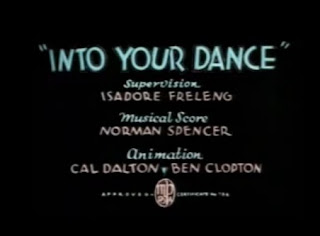
Into Your Dance (Not Into Your Stereotypes)


Director: Friz Freleng

Summary: Captain Benny's Showboat is in town, featuring a Porky Pig-looking conductor who gets booed off the stage (until he dons a flimsy disguise) and an amateur hour featuring the cow teacher Miss Cud from "I Haven't Got a Hat," a tough-guy boxer reciting sweetheart poetry, and a stuttering anthropomorphic dog reciting the titular song and driving away the audience.

The Channel: Cartoon Network (don't know the exact show this would have been on. Judging by the fact that it's a mid-1930s musical short with none of the well-known characters, I'm going to assume it ran on The Acme Hour, since a lot of obscure WB cartoons aired there, particularly on the weekday 6:00 in the morning version that actually ran for an hour with commercials, not the two-hour, Saturday version where the cartoons were a bit more on the mainstream, "I remember seeing that as a kid on [insert channel/home media release here]" side).

Part(s) Edited: A little light in the edit department today. All that was edited when this aired on Cartoon Network (which didn't last very long) was the scene of the four-man minstrel show singing the title song as people pour in to Captain Benny's Showboat.

How It Plays Edited/Video Comparison: I think the video comparison says it all. While the black-out here isn't as quick as what Cartoon Network usually does with its scene transition edits, I feel like I did capture the spirit of the edit:


Availability Uncut: On physical media, it's available on the Golden Age of Looney Tunes laserdisc set (volume 5, side 4) and as a special feature on the DVD version of the movie, Annie Oakley, starring Barbara Stanwyck, Preston Foster, and Melvyn Douglas. Over on streaming and digital media, it's surprisingly available uncut, uncensored, and restored/remastered on HBO Max (now known as "Max"), despite "Those Beautiful Dames" also being available on the same platform, but with cuts to outdated black caricatures. And believe me: minstrel show men (whether they're actual black men or white men in blackface, since that's what a minstrel show is/was) are just as stereotypical to show in the modern day as a black girl in pickaninny braids. What makes one more acceptable to show than the other?

Monday, October 28, 2024

Those Beautiful Dames (A Shamn Dame)


Director: Friz Freleng (credited as “Isadore Freleng”)
Summary: This is more-or-less "The Shanty Where Santy Claus Lives," only it's about an orphan girl who wishes to have toys, but is too poor to buy one. Instead of Santa coming to give her toys, the toys come to her run-down shack to cheer her up by giving her a home makeover (a modest one for the 1930s) and throwing her a party with cake and ice cream. Cute kids' fantasy stuff.
The Channel: unnamed syndication, Cartoon Network, and streaming (HBO Max [a.k.a Max])
Part(s) Edited/Video Evidence: Today, we have a two-fer (or three-fer, rather, but I only have evidence of two channels editing this short). Rather than explain it by writing it down (and because I recently installed DaVinci Resolve and gotten the hang of editing on non-linear video software, which is easier than what I used to do back when I was in film school), you can click here to see the video (if anything happens to the video, I will re-edit this blog).

How It Plays Edited: The Cartoon Network version where the Jazz Bow band scene was replaced with the scene of the toys gathered around the girl and the girl looking amazed that the toys she had seen in the store window are here and made over her broken-down shack has the most obvious "replace problematic scene with more benign footage" edit I've seen...so far (I'm not at the later cartoons yet). The edit done to the scene of the pickaninny girls next to the chocolate cake is similar (and looks and sounds obvious that something's missing) on both the Cartoon Network and (HBO) Max/streaming version, with the only notable differences being that the streaming version has more vibrant colors, the sound is clearer (the better to pick up on audio jumps, my dear), and there's no station identification bug at the bottom right of the screen.

Availability Uncut: Until a restored, remastered version that's uncut and uncensored resurfaces, your best bets to seeing this uncut are on the Golden Age of Looney Tunes laserdisc (volume 5, side 6) or as a special feature on the 2006 DVD release of the film Dames, starring Ruby Keeler and Dick Powell.

Tuesday, October 8, 2024

Buddy's Circus (Ubangi The Drum Slowly)


Director: Jack King

Summary: Buddy owns a circus filled with funny animals, non-white natives who can do strange things with their bodies, and a white baby who wandered in on the acts.

The Channel: Nickelodeon (Nick@Nite version of Looney Tunes on Nickelodeon)

Part(s) Edited: Every scene involving the Ubangi circus performers, including a scene where one of the aerial acrobats falls and catapults a baby off a seesaw and the scenes at the sideshow featuring Elastiko the Indian Rubber Man and Asbesto the Human Stove (the last one is not only an edit to get rid of outdated African/otherwise non-white native caricatures, but also an edit for dangerous behavior involving swallowing fire. This is going by my observations, since this was not mentioned on the old Censored Cartoons Page or the Looney Tunes wiki) was cut.

How It Plays Edited/Video Comparison: The first part with the Ubangi Brothers (though the one with oranges for breasts and a skirt is very much a woman. Not a particularly flattering depiction of an African native woman, but what do you expect from 1934?), Elastiko the Indian Rubber Man, and Asbesto the Human stove being cut is no big loss, since it's just a compilation of gags with no real bearing on the story. The second part with the baby getting catapulted...the only criticism I can give is that there's a minor continuity error that not even a diagonal wipe effect that looks like it was part of the cartoon can save:


Availability Uncut: Surprisingly, this is available on home media, uncut, uncensored, and remastered. Your choices are either the Looney Tunes Golden Collection (volume six) DVD set or the Blu-ray version of the Wheeler and Woosley film, Kentucky Kernels. It's probably not going to be on streaming or digital download any time soon, so get it while it's hot on disc.

Tuesday, October 1, 2024

How Do I Know It's Sunday? (Why Should You Care It's Edited)


Director: Friz Freleng

Summary: It’s a “products/label mascots come to life to sing the title song and perform in a closed store” cartoon, but, instead of taking place at night, it takes place on a Sunday during daylight hours, when most, if not all, stores would be closed so people can go to church and rest.

The Channel: Nickelodeon (Nick@Nite version of Looney Tunes on Nickelodeon, because where else would this air? I think I would have remembered it on the daytime version where it was nothing but the post-1964 Daffy Duck/Speedy Gonzales cartoons, the post-1964 Road Runner and Wile E. Coyote cartoons made without Chuck Jones’ involvement, the redrawn- and computer-colorized Porky Pig cartoons from the 1930s, the Pepe Le Pew shorts made after 1949’s “For Scent-imental Reasons”, and the semi-forgotten, “underrated gems” shorts -- both one-shot and with established characters --  that aired between 1949 and 1963).

Part(s) Edited: Just two scenes of outdated black/African-American stereotyping:

  • The black chef on the Scream Wheat (Cream of Wheat) box singing along with the mammy caricature on the box of Aunt Eliza (Aunt Jemima, now known as Pearl Milling) during the title song. I don’t know if the shot of them in the background was cut too, but, for the purposes of the approximation, I’m going to leave it in because I feel that that’s what Nickelodeon did.
  • The kid mascots using the ceiling fan as a merry-go-round -- not because it’s dangerous behavior that can easily be imitated by young, impressionable viewers, but because there are two black caricatures riding on the ceiling fan blades.
How It Plays Edited/Video Comparison: As I've mentioned before: cartoons like this don't lose much in terms of story or plot when it comes to being edited for either time or content (mostly content). With this one, however, I'm amazed there weren't more cuts to outdated racial and ethnic stereotypes. I'm guessing it would have led to a very choppy and incoherent cartoon if Nickelodeon went in that direction. If I wanted a musical cartoon that's severely edited to get rid of outdated racial and ethnic stereotypes, I can watch the Cartoon Network cut of "September in the Rain" (and I have. Thanks a lot, Acme Hour). Here's the approximation compare and contrast video:

Availability Uncut: If you can believe it, this actually has a home media release -- two of them, in fact. It was first released on the Looney Tunes Collector’s Edition VHS (volume 5’s “Musical Masterpieces”) in 2000. Eight years later, it was released on DVD as part of the sixth and final Looney Tunes Golden Collection set (it’s on disc three, which is dedicated to the Bosko, Buddy, and one-shot musical black and white cartoons).

Friday, August 23, 2024

I've Got to Sing a Torch Song (The Trouble is Not Your Radio Set...)


Director: Tom Palmer (planned and credited); Isadore “Friz” Freleng (finished and uncredited)

Summary: The antics of a radio station run by Ed Wynn, featuring many racial and ethnic caricatures enjoying the broadcast worldwide and the title song sung by caricatures of Greta Garbo, ZaSu Pitts, and Mae West. As far as Looney Tunes/Merrie Melodies fans are concerned, this one is under-the-radar for good reason. It was made when Harman and Ising finally left Warner Bros. Studios and Leon Schlesinger was desperately scrambling for replacement talent. Tom Palmer (the original director) was supposed to be that talent, but his original versions of this and “Buddy’s Day Out” were so bad that Friz Freleng (back when he was credited as either “Isadore Freleng” or “I. Freleng”) was called to salvage the trainwrecks.

The Channel: Nickelodeon (Nick@Nite version of Looney Tunes on Nickelodeon)

Part(s) Edited:

The old Censored Cartoons Page listed this short’s edits as, “Scenes of the Chinese police and African cannibals were edited out of this cartoon's black-and-white print.” 

And, they are right: there was a scene featuring Chinese police officers sleeping in a rickshaw and tying up the police radio transmitter so they won't be bothered by their boss when he calls for all cars to report to an unknown crime that was cut when Nickelodeon aired this as part of their Nick@Nite version of Looney Tunes on Nick (original airdate: August 4, 1991. The Nick@Nite Looney Tunes on Nickelodeon came on between 1988 and 1992 while the installment show itself lasted until 1999, though I never saw Looney Tunes on Nickelodeon after 1996, mostly because the cable wasn’t on much at my house and mostly because this was when Nickelodeon was airing more of its original programming rather than what they had imported from other countries and syndicated domestically), but there was only one scene featuring an African cannibal (just one, not a group of them), and that was the scene of the African cannibal tuning in to a cooking show on his skull radio and adding mustard and salt to his stew of white explorers (shown as caricatures of 1930s vaudeville and film comedians Bert Wheeler and Robert Woosley) before stirring them.

And th-th-th-that’s not all, folks! The good people who used to run the Censored Cartoons Page forgot to mention two more edits that Nickelodeon did:

  • The scene of the Bing Crosby caricature Cros Bingsby crooning, "Why Can't This Night Go On Forever?" cut the brief shot of college coeds (some of which are shown in skimpy lingerie) listening to the broadcast, though the old spinster hugging and kissing her radio while listening to the broadcast as well wasn’t censored.
  • The sequence of the radio show reaching international audiences had a scene of an Arab sheik shooing away his belly-dancing concubine and switching over to a broadcast of Amos 'n Andy in the uncut version. Nickelodeon’s version redubbed the Amos ‘n Andy broadcast with music from the beginning of the short.

How It Plays Edited:

1) The Cros Bingsby/coed part: Other than a mildly obvious audio skip (and the hypocrisy of leaving in the old spinster making out with a radio when the college coed part wasn’t as sexually provocative as Nickelodeon’s cut makes it out to be), this isn’t too bad.

2) The Chinese police/cannibal part: Okay, the hypocrisy of this cut is starting to annoy me. They left in the Inuit/Eskimo man listening to the radio and nearly getting swallowed by a whale. I can only handle one instance of selective censorship at a time.

3) The Amos ‘n Andy redub: Eh, the music makes the scene feel a bit off. Why would the sheik shoo away his concubine just to listen to some music when he was already listening to music? I guess it can be written off as, “He was sick of the music from his country and wanted to listen to something different, since this is a sequence showing Ed Wynn’s radio show hitting international audiences,” but even that’s pushing it.

And what’s odd about all of this is that I was given the edited Nickelodeon copy from a tape trade and a few years later, the cartoon itself was released on DVD (see “Availability Uncut” below), so I did what every amateur animation critic should do: I watched them side by side to see what was cut and what wasn’t. The old Censored Cartoons Page, sadly, didn’t correct the mistake, so I had to make do with the Looney Tunes Fandom wiki and, of course, this blog here.

Video Comparison: The video was too big to load on the blog, so click here to see for yourself. (EDIT: 11/7/25: I'm going to redo the compare/contrast video on this, as I did a bad job on it the first time. Since this is one of my most popular posts, stay tuned for a new version).

Availability Uncut: This under-the-radar short surprisingly has been released on physical media. It’s on the DVD and Blu-ray version of the film Gold Diggers of 1933 (since the title song is also heard in the movie) and it’s on the fifth volume of the Looney Tunes Golden Collection DVD set. Archive.org has it online (for now), but it’s not on YouTube, unless you want to see clips of how it was censored on Nickelodeon or one of the audio commentary reviews from Anthony’s Animation Talk.

Monday, August 19, 2024

The Shanty Where Santy Claus Lives (A Recycled Mess, or I'm Dreaming of a Black Christmas)


Director: Rudolf Ising

Summary: On a cold and snowy Christmas Eve during the Great Depression, an orphan boy is visited by Santa Claus and joins him on his sleigh ride back to the North Pole, where the boy gets to play with all the toys Santa has in his workshop.

The Channel: Cartoon Network (on Late Night Black and White)

Part(s) Edited: If you think a wholesome cartoon like this couldn’t possibly have problematic content in it, then this must be your first time here. The second half of the cartoon does have some outdated depictions of African-Americans (like most cartoons of the time) and Cartoon Network cut the following that they felt was offensive:

  • The orphan boy winding up the Sambo Jazz Band toy (“sambo” being an offensive term for a black person, though it’s more for someone from South India, not an African-American, as there’s a children’s book called Little Black Sambo and it’s supposed to be about a South Indian, not an African-American. It was probably used as a slur for both either way). The Sambo Jazz Band toy was also seen (and edited on Cartoon Network) on the MGM cartoon, “Toyland Broadcast” (which I had on a video featuring Christmas-themed MGM cartoons and loved as a kid, despite the outdated racial and ethnic stereotypes).
  • A white baby doll falling into a coal bucket and coming out in blackface, doing the Al Jolson “Mammy!” schtick, with an actual mammy doll responding, “Sonny boy!”
  • The title character and her black back-up singers from “Red-Headed Baby” appearing again to sing “The Shanty Where Santy Claus Lives.”

How It Plays Edited: The Looney Tunes wiki and the old Censored Cartoons Page have described the edited version as “severe.” While the edits do make some of the scenes feel disjointed, it pales in comparison to the actual severe edits seen on “September in the Rain,” “Bacall to Arms”, and most of the post-1948 Warner Bros shorts aired on free TV (particularly on ABC and CBS, though NBC’s take on “The Turn-Tale Wolf” and The WB’s hatchet job editing to “A Star is Bored” qualify).

Video Comparison: 

Uncut version:


Edited Version:


Availability Uncut: This is a public domain cartoon (has been since 1962), so it’s not too hard to find on YouTube or whatever YouTube substitute you prefer. If you’re a physical media fan, then you can find it on either the Golden Age of Looney Tunes laserdisc (volume 3, side one, dedicated to Harman-Ising cartoons), as a special feature on the DVD version of the 1933 film Lady Killer starring James Cagney, or as a special feature volume three of The Warner Gangsters Collection. It's also been mocked on Rifftrax, the modern, YouTube generation version of Mystery Science Theater 3000.

It should also be of note that this is the last Harman-Ising short that’s in the public domain in the United States (for now, at least) and the only public domain short in 1933, which means that the rest of the censored cartoons I go through are still under copyright (unless otherwise noted, as there are some 1930s and 1940s cartoons that have fallen into the public domain and a few were made as educational/propaganda material for the U.S. government, so they never had copyrights to begin with) and I’ll have to change how I do the video comparisons to reflect that.

Saturday, August 3, 2024

Freddy the Freshman (Cheer Factor)

Director: Rudolf Ising

Summary: A one-shot musical cartoon centered on “Freddy the Freshman,” a college upstart who crashes a pep rally and wins the unnamed college’s big game.

The Channel: Cartoon Network (Late Night Black and White)

Part(s) Edited: A brief scene featuring three Jewish parrots (with pennants in Hebrew) and a stereotypically homosexual chicken (the sissy stereotype that was popular in pre-Code films, if you can believe it) as cheerleaders during the big game was cut. Despite this, the unaired ToonHeads special, The Twelve Missing Hares (a special that would have shown clips of the 12 Bugs Bunny cartoons that were supposed to be a part of the 2001 June Bugs weekend marathon, but were pulled for being too racially insensitive, even though most have aired on Cartoon Network and other channels before) had the offending clip (despite that it is not a Bugs Bunny cartoon, nor was it made when Bugs Bunny was created) as an example of how older Warner Bros cartoons had racial, ethnic, and, in the case of the homosexual chicken, sexual stereotypes that would be considered offensive by modern standards.

How It Plays Edited: Since the short is thinly-plotted with only the title song and some visual gags keeping it from falling apart, the edit doesn’t really make or break the short. What gets me, however, is the whole “Cartoon Network still used that scene on a special that never aired to illustrate the reason why the special -- and the cartoons within that special -- will never air” deal. And if it weren’t for amateur home media sleuths who ended up finding said lost special about banned cartoons, you would have thought that I was having a stroke or suffering from burnout while typing this.

Uncut version: 


Edited version (created by me as an approximation, as I can't find any actual footage):


Uncut clip as shown on The Twelve Missing Hares (all credit and blame go to Jerico Dvorak, whose YouTube channel is filled with lost and rare media. The controversial scene starts at 4:26):


Availability Uncut: Has been in the public domain since 1961, so you can watch it online without breaking any copyright laws. If that’s not your thing, then there’s always The Golden Age of Looney Tunes laserdisc from 1992 (volume three, side 7) or the Blu-ray version of The Mask of Fu Manchu, which was released this year (2024), where it’s a special feature.


Thursday, August 1, 2024

You Don't Know What You're Doin' (Suffering From Car Exhaust-ion)


Director: Rudolf Ising

Summary: In this, the debut cartoon of Bosko clone, Piggy, our title character takes his date, Fluffy, out for a night at the orchestra playing the title song. The date goes pear-shaped when Piggy mocks the orchestra for not knowing what they’re doing and gets a contact high from some heckling drunks.

The Channel(s): The edited version I found was from a channel called QTV, which could either be a channel in Scotland, The Gambia, or Pakistan. I’m going to go for Scotland or possibly The Gambia, because I can’t imagine a Pakistani channel airing this due to the sequence with the drunks (Pakistan is a Muslim country and alcohol anything is considered taboo to their religion).

Part(s) Edited: Light edit this time around: the part where Piggy’s scooter farts his exhaust in the snooty usher’s general direction and the usher finding himself in blackface and doing the Al Jolson “Mammy!” plea to the camera cuts off before the usher finds himself in blackface, going from that scene to the curtain that reads, “Asbestos” and the band playing as Piggy and Fluffy come in.

How It Plays With the Edit: The edit is fairly obvious…for those who’ve seen the uncut version before. If you haven’t or aren’t familiar with the recurring gags in the earlier Warner Bros shorts, you probably wouldn’t know the scene was there. As always, here is a video comparison:

(original version)

(redrawn, colorized censored version)

Availability Uncut: While it has been in the public domain since 1959 and can easy be found on online video sites, “You Don’t Know What You’re Doin’” has had two official releases. It was first released in 1992 on the Golden Age of Looney Tunes laserdisc (second volume. It’s on side one of the disc called “Musical Madness,” which is an apt description of the short). Its most recent release was in 2008, on the sixth volume of the Looney Tunes Golden Collection DVD, on the third disc dedicated to the early black and white shorts.

Correction: The most recent sighting of “You Don’t Know What You’re Doin’!” on home media is actually as a special feature on the third volume of Warner Archive’s “Forbidden Hollywood” DVD collection, celebrating the racy and scandalous films (by early 1930s standards, though some of it could still hold up) made before the Hays Code cracked down on salacious content in mid-1934. The third volume features such films as Other Men’s Women, The Purchase Price, Frisco Jenny, Midnight Mary, Heroes for Sale, and Wild Boys of the Road. The pre-Hays Code era really knew how to title a movie.


Labels