Showing posts with label specialpost. Show all posts

Tuesday, April 1, 2025

Tokio Jokio (The Jokio's On Me)

In researching and gathering evidence of TV channels censoring the classic Warner Bros. shorts (and some post-classics as seen with “The Duxorcist,” “Blooper Bunny,” and “Museum Scream”), I do come across false evidence and conjecture that I either try to disprove or leave as legitimate evidence until proven otherwise. Well, this one I fell for hook, line, and sinker until proven otherwise. Why? Because I thought it was completely reasonable and believable that it would and could happen. So, in the spirit of April 1st (April Fools' Day), please enjoy this brief post:


Director
: Norm McCabe (planned, credited as “Cpl. Norm McCabe”); Frank Tashlin (completed, uncredited)

Summary: A newsreel spoof of “vicious Japanazi propaganda,” showing the inner workings of one of our enemies during World War II…and just how incompetent they are, because this is U.S. propaganda against our enemies of the time, so, of course, we’re going to play just as dirty as they did.

Normally, this is where the “Channel” and “Part(s) Cut” segments would be, but not this time. It’s pretty clear that this cartoon never saw the light of day after it premiered in theaters, due to its heavy World War II references and offensive caricatures of Japanese people. However, I do want to point out that this short came close to airing in the modern day not counting that ToonHeads special about World War II cartoons (on that version, “Tokio Jokio” [a] wasn’t shown in full, but I watched the short enough times to recognize the scenes, and [b] actually was prefaced with the warning that the caricatures were unflattering and cruel by today’s standards. I don’t see Nickelodeon being that sensitive and discreet about such matters).

Nickelodeon (back when they had the rights to air Warner Bros cartoons as part of their Looney Tunes on Nickelodeon installment show) actually had the rights to air this, as well as “Goin’ to Heaven on a Mule” (a.k.a, “the Censored Eleven Cartoon that Could Have Been, But Never Was”), the 1938 version of “Injun Trouble” starring Porky Pig, the 1969 version of “Injun Trouble” that starred Cool Cat and was the final new Warner Bros short released theatrically (but not the last one overall), and “The Ducktators” (another World War II cartoon directed by Norm McCabe and one most people actually like more than “Tokio Jokio”), among other shorts. Of course, no censor in their right mind aired “Tokio Jokio” or any of the other shorts listed here (and some that weren’t, but were on the Looney Tunes Fandom Wiki page for Nickelodeon), not even in edited form, because an edited version of this would be too short and too nonsensical (even though this is one of those “string of gags” shorts and not one with an actual story) to air on television.

…which brings me to this point. When I was looking for video evidence of how the Warner Bros cartoons were censored on television, I came across a YouTube channel that has since been shut down that had what I thought was evidence that “Tokio Jokio” did air on Nickelodeon with parts cut (a lot of parts cut) before being phased out for other shorts. It seemed believable. Nickelodeon aired a lot of obscure and second- (third-, and sometimes fourth-) tier post-1948 shorts that the others channels wouldn’t touch...until Cartoon Network got their hands on them, so airing an obscure black and white World War II short could have made its brief, but memorable rounds before being yanked due to complaints from parents and/or racial advocacy groups or the censors sobering up and realizing their mistake felt like something Nickelodeon would do.

Turns out that wasn’t the case. Just as I had published my discovery on the Looney Tunes Fandom Wiki page for “Tokio Jokio,” it was taken down. I wasn’t punished for it, but I did feel kind of foolish. That’s why I do my best here to make sure my posts are accurate and welcome anyone who feels otherwise to tell me so, so I can correct my mistakes.

Video Comparison: I’m not going to explain how it plays uncut vs how it plays edited because this is one of those “You have to see it to believe it” moments. Plus, for a video alleging that it’s proof that Nickelodeon aired “Tokio Jokio,” whoever created it did their homework on how it hypothetically would be edited. That’s why I fell for it.

Uncut Version:


(Allegedly) Edited Version:


Availability Uncut: Considering how loathed it is in most classic cartoon fan circles, you can bet that no one is clamoring for this to be remastered and released for public consumption, at least not until a proper WWII cartoon collection on DVD, Blu-ray, and 4K finally gets created. However, for the purist completionist collector and the morbidly curious, “Tokio Jokio” is readily available on online video sites, as it’s been in the public domain since 1971.

Monday, September 2, 2024

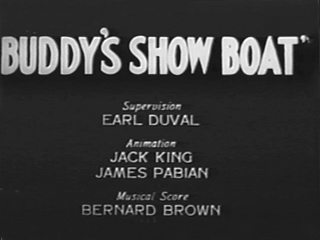
Buddy's Show Boat (Cup and Saucer Lip)

We’re now in the Buddy era of Warner Bros animation, considered a real valley in the studio’s peak-and-valley history. Following the departures of Harman and Ising, the studio was desperately scrambling for a new director and a new star character. Tom Palmer was a failure (as seen with “Buddy’s Day Out” [which wasn’t edited for anything when aired on American television -- as far as anyone knows, though considering how anodyne that short is, it probably wasn’t cut for anything] and “I’ve Got to Sing a Torch Song” [which was cut for a lot on Nickelodeon]), and Buddy himself would be derided for being a mediocre clone of Bosko. Of the 24 Buddy cartoons that were released between 1933 and 1935, only five were shown edited on American TV (mostly Nickelodeon, but at least one was cut when syndicated to television in the 1950s and ‘60s). 

Because of this (and my healing from seasonal allergies to my eyes), posting will be a bit less frequent.

NOTE: The compare/contrast video I did isn't actually ten minutes long. I made a mistake in pacing and editing when I was creating it. I will make a new video (and replace the YouTube videos on other posts that were taken down due to copyright), but it's going to be a while.

----------------------------------------------------------

Director: Earl Duvall (misspelled as “Duval”)

Summary: Buddy has a traveling showboat, featuring dancing girls, African natives who can impersonate white French performers, and walruses that save Buddy’s girlfriend, Cookie, from a nameless thug (the same one from “Buddy’s Beer Garden” who hit on Buddy when he was cross-dressed as Mae West. I got it linked if you want to see the insanity for yourself).

The Channel: Nickelodeon (Nick@Nite version of Looney Tunes on Nickelodeon)

Part(s) Edited: Two scenes featuring stereotypically black performers were cut/altered:

  • Both scenes at the beginning with Buddy piloting his showboat were cut to remove all scenes featuring the black coal workers singing "Swanee River" and stoking coal into the furnace (which magically has a mouth and eyes for no reason other than "1930s cartoons were weird"). While the audio was kept, the first visual was replaced with Buddy at the wheel of his showboat and the beginning of the scene with two sleeping guys holding fishing rods before the scene pans to two daschunds walking on the riverboat paddle and sniffing at two hot dogs hanging on the edge of the fishing rods. The second time, it just cut to a fish spitting at the bad guy after he spat at the fish first. The Video Comparison section provides a better look at how it was cut.
  • Buddy introducing the African native as "Chief Saucer Lip" was completely cut, going from the audience cheering and applauding over Buddy and Cookie dancing with the chorus girls to Chief Saucer Lip's Maurice Chevalier impression.
What Wasn't Cut that Should Have Been Cut: 

  • The chorus girls wearing nothing but bras and panties (hey, if "I've Got to Sing a Torch Song" can be shown on Nickelodeon without the scene with the college coeds listening to Cros Bingsby in their pajamas/underwear, then Nickelodeon could have done away with that part. However, I think it cropping the scene or replacing it with alternate footage would have been too distracting. It didn't stop them from editing the black coal worker scenes, though). 

  • The bells on the old-timey telephone jiggling like breasts (again, Nickelodeon really shouldn't have picked and chose what was suggestive humor and what wasn't, especially if they're dealing with a pre-Code cartoon from 1933). 

  • The minstrel quartet welcoming people in to see Buddy's traveling show. When I get to "Go Into Your Dance," you'll see why Nickelodeon should have edited this.

How It Played Edited/Video Comparison: The first edit (with the coal workers) makes it obvious that something's cut, which doesn't mean much to something that has little to no story, but it means everything if you're trying to make the music match the visuals. Cutting to recycled footage can be a bit distracting. As for the second edit? Kind of abrupt, but it doesn't affect anything. As always, here's a compare/contrast video I made (click here).

Availability Uncut: As of this writing (2024), there's no home media or streaming release of this short. It was on TV under Sunset Productions from 1955 to 1968 and Nickelodeon did air the edited version between 1988 and 1993 (the installment that aired this short, according to the Looney Tunes wiki premiered on September 16, 1990), but, outside of rare appearances on online video sites (mostly archive.org), there's nothing.

Labels