Showing posts with label Warner Bros.. Show all posts

Monday, February 17, 2025

The Cat Came Back (Plunger, Mousetrap, Poke 'Er Eye)

Quick note before I start: I know I said I was going to change up the blog and take it to a new direction, but I have five entries on the back burner formatted in the old style. For ease of transition (and because I'm still thinking of new ways [or a new way] to approach my entries), the entries to this short, Milk and Money/Porky's Prize Pony, I Love to Singa, and The Village Smithy will be in this style. After another full post covering a group of similarly censored cartoons (it will either be the Banned Bugs Bunny 12 or The Hunter's Trilogy), I will transition over to my as-yet new style (I am considering a podcast-style transcription with accompanying video and picture stills, but nothing is set in stone yet). So, enjoy these last five entries as they are.

Director: Friz Freleng

Summary: In this platonic version of Romeo and Juliet, a kitten and a mouse, despite being taught by their respective mothers that they and their kind are sworn enemies of the other, run off and become friends. When the two end up getting trapped in a sewer, will the two warring families put aside their differences and save their children?

The Channel: Unnamed syndication

Part(s) Edited: Going by the old Censored Cartoons Page and the Looney Tunes wiki, there are four parts edited for seemingly no reason (though at least one part has a justified reason for being edited).

  • The momma mouse training her kids on how to run through a mousetrap without getting caught
  • The momma cat getting poked in the eyes (and the momma cat poking the momma mouse in the eyes after thinking back to why they're enemies in the first place) [this counts as two cuts, and is probably the only justified edit, as eye-poking is often considered dangerous, imitable slapstick violence, especially if you've ever seen a Three Stooges short with the classic trio of Moe, Larry, and Curly]
  • The momma mouse using a plunger to get the kitten and mouse out of the sewer.
Please Note: the accompany video refers to the momma mouse as a "momma rat." That's my bad for doing these on lack of adequate sleep.

How It Plays Edited/Video Comparison: Not too bad, though the eye-poking part being edited is obvious. Without it, there's no reason why the momma cat and mouse hate each other (besides the fact that cats and mice don't get along anyway). Here's the compare/contrast clip:


Please Note #2: I switched over to Filmora for this video because it works better. There's a watermark on it because I have the free version. Somewhere on this journey, I will get a paid version, but that's probably not going to happen. DaVinci Resolve is good and I will come back to it, but Filmora has better features and I will stick with it unless otherwise noted.

Availability Uncut: It is available for streaming (uncut, naturally. It's not problematic by modern standards, outside of some violence, drowning peril, and species discrimination, but it's cute and charming enough to get away with it) on HBO Max (now called "Max"). If you're looking for a physical release of it, there's only two choices: The Golden Age of Looney Tunes laserdisc set (volume 5, side 5, "Pesky Pets") or the Blu-ray version of the movie The Walking Dead (no relation to the graphic novel or the AMC series) starring Boris Karloff and Ricardo Cortez.

Update: As of 2025, “The Cat Came Back” is not on HBO Max (a.k.a Max) anymore. It is uploaded on Tubi.

Sunday, November 17, 2024

Billboard Frolics (Shokus All Night Long)


Director: Isadore "Friz" Freleng (credited as "I. Freleng")

Summary: It's a "things come to life and put on a show" cartoon, but instead of a grocery store, a department store, or the ever-popular bookstore, it's an alley filled with billboards on or around buildings. There is a story of a baby chick from one of the ads getting chased by an alley cat after getting owned by a worm in an apple, but that's buried beneath all the other gags. 

Fun Facts: Probably the only noteworthy thing about this short is that this is the first appearance of "Merrily We Roll Along," which is one of two theme songs associated with the Looney Tunes and Merrie Melodies cartoons. While it doesn't really matter now since both are used interchangably, I'd like to remind casual fans of classic cartoons that the Merrie Melodies' theme is "Merrily, We Roll Along" while Looney Tunes' theme is "The Merry-Go-Round Broke Down," which was heard on the 1937 short "Sweet Sioux," but wasn't used as the Looney Tunes theme until "Rover's Rival".

The Channel: Home media release (Shokus Video's Cartoon Collection, third volume)

Part(s) Edited: Curiously, the scene of the baby chick getting inflated with a tire pump while chasing the worm from the apple was cut. A scene of mild slapstick like this normally wouldn't be cut on television, much less home media release, so I'm as lost as you are when it comes to explaining why it would be edited. I'm just going to assume that this is either a time/pacing cut brought on by either the cartoon going on for too long or, since Shokus Video is one of those gray-market public domain video companies that probably took some cartoon shorts that were still under copyright, some parts had to be trimmed for legal reasons (though if that were the case, why was the beginning with Eddie Camphor and Rub-Em-Off singing "Merrily, We Roll Along" not cut? Seems like the easy target).

Looney Tunes Wiki also claims that there may be a cut between the woman's underclothes dancing and the scene of the chick in the billboard ad chasing after the worm, but I'm going to cover that on my blog page about cartoon shorts that may have been edited, but there currently is little to no evidence of the deleted scenes existing.

What Wasn't Cut, But Should Have Been: The cigarette-smoking penguins doing the same dance as the wooden ducks on "Beauty and the Beast," only now the snow is abrasive, powdered cleanser for sinks and bathroom fixtures rather than soda crackers being put through an electric fan. I could see some unnamed syndicated versions doing it, but mostly, I see Cartoon Network and Boomerang temporarily editing this because one of their taboos is showing characters smoking cigarettes. I say "temporarily" because I can also see this being shown edited initially, then shown uncut before getting phased out.

How It Plays Edited/Video Comparison: Going by how I edited it (based on what Looney Tunes wiki states), it looks obvious that something's missing. This is evident in the audio side of things rather than the visual, but I will let you, the viewer, judge for yourself.


Availability Uncut: Besides the Shokus Video's Cartoon Collection print, there are versions of this short that are available uncut and uncensored. The version I used for the compare/contrast video is from MeTV (an over-the-air channel that airs classic cartoon shorts, as well as older live-action TV shows) and that version is uncut (barring the alleged edit I mentioned above). The Golden Age of Looney Tunes laserdisc (volume 4, side 10) had this uncut, as well as the 2005 DVD release of the film Captain Blood, starring Errol Flynn and Olivia de Havilland. It used to be on Max (formerly known as "HBO Max") when the streaming service was first released in 2020, but it has since been pulled. Why? I don't know. There's nothing problematic about it (unless you count the Rub-Em-Off, the Russian violin [or "wioleen"] player, but most don't. I feel this might have been dropped because no one was streaming it, which is a shame, because it does look good restored). As of this writing, it hasn't been released anywhere else besides those places, but things could change...

Update: …and they did. “Billboard Frolics” is on Tubi as of 2025.

Thursday, October 31, 2024

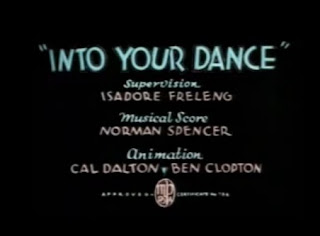
Into Your Dance (Not Into Your Stereotypes)


Director: Friz Freleng

Summary: Captain Benny's Showboat is in town, featuring a Porky Pig-looking conductor who gets booed off the stage (until he dons a flimsy disguise) and an amateur hour featuring the cow teacher Miss Cud from "I Haven't Got a Hat," a tough-guy boxer reciting sweetheart poetry, and a stuttering anthropomorphic dog reciting the titular song and driving away the audience.

The Channel: Cartoon Network (don't know the exact show this would have been on. Judging by the fact that it's a mid-1930s musical short with none of the well-known characters, I'm going to assume it ran on The Acme Hour, since a lot of obscure WB cartoons aired there, particularly on the weekday 6:00 in the morning version that actually ran for an hour with commercials, not the two-hour, Saturday version where the cartoons were a bit more on the mainstream, "I remember seeing that as a kid on [insert channel/home media release here]" side).

Part(s) Edited: A little light in the edit department today. All that was edited when this aired on Cartoon Network (which didn't last very long) was the scene of the four-man minstrel show singing the title song as people pour in to Captain Benny's Showboat.

How It Plays Edited/Video Comparison: I think the video comparison says it all. While the black-out here isn't as quick as what Cartoon Network usually does with its scene transition edits, I feel like I did capture the spirit of the edit:


Availability Uncut: On physical media, it's available on the Golden Age of Looney Tunes laserdisc set (volume 5, side 4) and as a special feature on the DVD version of the movie, Annie Oakley, starring Barbara Stanwyck, Preston Foster, and Melvyn Douglas. Over on streaming and digital media, it's surprisingly available uncut, uncensored, and restored/remastered on HBO Max (now known as "Max"), despite "Those Beautiful Dames" also being available on the same platform, but with cuts to outdated black caricatures. And believe me: minstrel show men (whether they're actual black men or white men in blackface, since that's what a minstrel show is/was) are just as stereotypical to show in the modern day as a black girl in pickaninny braids. What makes one more acceptable to show than the other?

Monday, October 28, 2024

Those Beautiful Dames (A Shamn Dame)


Director: Friz Freleng (credited as “Isadore Freleng”)
Summary: This is more-or-less "The Shanty Where Santy Claus Lives," only it's about an orphan girl who wishes to have toys, but is too poor to buy one. Instead of Santa coming to give her toys, the toys come to her run-down shack to cheer her up by giving her a home makeover (a modest one for the 1930s) and throwing her a party with cake and ice cream. Cute kids' fantasy stuff.
The Channel: unnamed syndication, Cartoon Network, and streaming (HBO Max [a.k.a Max])
Part(s) Edited/Video Evidence: Today, we have a two-fer (or three-fer, rather, but I only have evidence of two channels editing this short). Rather than explain it by writing it down (and because I recently installed DaVinci Resolve and gotten the hang of editing on non-linear video software, which is easier than what I used to do back when I was in film school), you can click here to see the video (if anything happens to the video, I will re-edit this blog).

How It Plays Edited: The Cartoon Network version where the Jazz Bow band scene was replaced with the scene of the toys gathered around the girl and the girl looking amazed that the toys she had seen in the store window are here and made over her broken-down shack has the most obvious "replace problematic scene with more benign footage" edit I've seen...so far (I'm not at the later cartoons yet). The edit done to the scene of the pickaninny girls next to the chocolate cake is similar (and looks and sounds obvious that something's missing) on both the Cartoon Network and (HBO) Max/streaming version, with the only notable differences being that the streaming version has more vibrant colors, the sound is clearer (the better to pick up on audio jumps, my dear), and there's no station identification bug at the bottom right of the screen.

Availability Uncut: Until a restored, remastered version that's uncut and uncensored resurfaces, your best bets to seeing this uncut are on the Golden Age of Looney Tunes laserdisc (volume 5, side 6) or as a special feature on the 2006 DVD release of the film Dames, starring Ruby Keeler and Dick Powell.

Thursday, August 22, 2024

Bosko's Picture Show (Hit-ler and Miss, or Meet the Fawkers)


Director: Hugh Harmon and Isadore "Friz" Freleng

Summary: In this, the last Bosko short made for Warner Bros/Leon Schelsinger studios, Bosko shows viewers what a night at the movies was like back in the early 1930s. There were sing-alongs with actual in-house organ players, a newsreel showing world events, a short film featuring comedy duo Laurel and Hardy (though some theaters showed other shorts from comedy duos -- and trios, in the case of The Three Stooges), and a melodrama where Honey is in danger of being kidnapped by Dirty Dalton (the cur!).

The Channel: Nickelodeon (Looney Tunes on Nickelodeon -- Nick @ Nite version; as of the second airing)

Part(s) Edited:

  • The “Out of Tone” newsreel sequence is missing the story of a Hollywood screen lover (Jimmy Durante) spending his vacation in Germany getting chased by Adolf Hitler (in what is commonly believed to be his first caricatured appearance in an American cartoon. “Cubby’s World Flight”, an obscure short made around the same time as this, is considered the first, but when was the last time you’ve heard someone talk about Cubby?) with an axe.
  • During the melodrama He Done Her Dirt (And How!), Bosko shouts “The dirty fuck!” when he sees Dirty Dalton (the cur!) sneak onscreen on a wheel-less bicycle. The first time Nickelodeon aired this short, that part wasn’t cut (or so it’s believed). Starting with the second time, “The dirty fuck!” was changed to “The dirty cur!” (with “cur” being recycled from the part near the end where Bosko yells, “Stop, you cur!” before jumping through the movie screen).

How It Plays Edited: The first cut doesn’t really affect the overall short. The abrupt cut in audio might hint at something missing, but it can logically be written off as a scene that was cut before theatrical release, not a scene that was edited when aired on television. As for the second cut, it’s obvious that something’s been changed, as this video will show you:


Availability Uncut: The only official release it has (as of 2024) is on the Looney Tunes Golden Collection volume six (on the third disc dedicated to Bosko, Buddy, and one-shot black and white musicals). As it’s still under copyright, you’re not going to find the whole thing on YouTube. You might find clips of the infamous “dirty fuck” line and a review/commentary or two, but no full cartoon. Archive.org does have it uncut, but even that website has had copyrighted videos taken down, so catch it while you can or just shell out money for an official release.

EDIT: “Bosko’s Picture Show” can also be found as a special feature on the Blu-ray release of the movie Lilly Turner, starring Ruth Chatterton and George Brent. The movie was released on Blu-ray this year; that’s why it was never mentioned until now.

Final Thoughts and Miscellany: If you’re wondering whether or not Bosko actually did call Dirty Dalton a “dirty fuck,” then you’re not alone. A lot of classic animation fans and historians have argued this. Some believe that Harman and Ising wouldn’t go that far, since this was the time that the Hays Code was in effect, but no one really took it seriously until mid-1934 (this cartoon was released in 1933, so dicey content in American movies still popped up here and there. You can visit pre-code.com or just look up “pre-Code movies” on YouTube or whatever search engine you prefer if you want to learn some American film history before its Golden Age) and think that Bosko called Dirty Dalton a “dirty fox” (which is the line in the closed captions/subtitles on the Looney Tunes Golden Collection volume six version) or a “dirty mug”. While Mark Kausler (animator and director of the 1991 animated version of Beauty and the Beast, the 1994 animated version of The Lion King, and 2001’s Osmosis Jones) thinks Bosko’s line was “the dirty mug,” according to lip sync and a perceived soundtrack flaw that turned an innocent word obscene, animation historian Jerry Beck had several people see the film, with all of them concluding that Bosko indeed called Dirty Dalton a “dirty fuck.” As for me, I believe Bosko did say “dirty fuck,” but it sounded more like “dirty fock” (rhymes with “hawk”). Guess if the short “u” sound was replaced with an "aw" digraph sound, no one would know the difference back then.

Then there’s the question of why Harman and Ising would let this slip. Was it because films back then were trying to be as subversive and obscene as possible, which caused the Hays Office to censor films more harshly after mid-1934, since the Code wasn’t as enforced as it should have been when it first came out in 1930? Were Harman and Ising so mad at Leon Schlesinger over budget issues that this was their “screw you”/“up yours”/“take this job and shove it” (all of which would be too rude to say or imply under the Hays Code, just so you know) moment that led them to go work for MGM? Or is it actually just an innocent word turned rude?

Tuesday, August 20, 2024

Bosko's Knight-Mare (Falling Stars)


Director:
Hugh Harman

Summary: Bosko dreams that he’s a Knight of the Round Table after falling asleep while reading a book on Arthurian legends.

The Channel: Nickelodeon (on the Nick @ Nite version of Looney Tunes on Nickelodeon)

Part(s) Edited: When Bosko first meets the Knights of the Round Table in his dream, the scenes showing the knights as popular celebrities of the day (Ed Wynn, Jimmy Durante, Mahatma Ghandi, and Oliver Hardy, with Bosko turning into Stan Laurel, Hardy hitting Laurel/Bosko and Laurel/Bosko whining over getting hit) was cut.

Opinion on the Edit: Yeah, there’s no real explanation behind his cut. Arguments can be made that the Ghandi caricature could be potentially offensive, as Mahatma Ghandi is a revered figure in Indian history, but I have a feeling that Nickelodeon left in caricatures of Ghandi in other early black and white Warner Bros shorts. Maybe there was some kind of licensing issue over the celebrity likenesses being depicted, but then all the celebrities caricatured here and in other shorts would have been cut. Since the only celebrities the Nickelodeon version allowed were the original Marx Brothers (back when Zeppo was included alongside Groucho, Harpo, and Chico), I’m going to assume that the cut was done because the scene simply ran too long and Nickelodeon needed to shorten the cartoon to make room for more shorts and, most importantly, more commercials.

How It Plays Edited: There’s an obvious skip in the audio track, but nothing too serious. That’s all I got.

Video Comparison: 


Availability Uncut: Yeah, there’s no real legal way to see this. It was on television back when Looney Tunes on Nickelodeon aired this in the late 1980s into the early 1990s. I’m not 100% sure if Cartoon Network ever aired this, since they did air black and white Warner Bros cartoons, but most of them were the one-shot musicals. As of 2024, it hasn’t been released on DVD, Blu-ray, or streaming (either as part of a WB short collection or as a special feature to a film). Since it’s under copyright, most video websites will take it down -- operative word being “most”. While YouTube may only have it available as part of a review (they used to have a video clip showing how it was edited on Nickelodeon, but that has since been taken down), DailyMotion has it uncut, as does Archive.org.

Wednesday, August 14, 2024

I Love a Parade (Wild Man Jo Jo's Bizarre Adventure)


Director: Rudolf Ising

Summary: Despite the song being about a parade, the whole short is a collection of gags involving a day at the circus, from an animal parade and an unlucky DSC cleaner following them to mice who use an ostrich and a slingshot to get into the circus for free to a tattooed freak (back when they were circus sideshow acts instead of part of the general population) showing off the swishy male face on top of his bald head, to conjoined twin (called “Siamese twin,” since this was before political correctness was invented) pigs smoking a cigar to a hula-dancing hippo accusing said tattooed freak of sexual harassment thanks to a mouse with a party favor horn to Mahatma Ghandi as a goat charmer, and ending on a lion with fleas.

The Channel: Cartoon Network (on an episode of Late Night Black and White).

Part(s) Edited: Despite the questionable gags involving a DSC clerk cleaning animal poop (which was cut from “Drip Along Daffy” on Cartoon Network, but the ulterior motive isn’t what you think), homosexuality, tobacco use, outdated terms for conjoined twins, and sexual harassment mentioned above, Cartoon Network found the scenes with Jo Jo the Wild Man (a stereotypical African native locked in a cage for the audience’s amusement) objectionable and had them cut. This wouldn’t be a problem, except for the fact that they left in the scenes with the Indian Rubber Man, who would also be considered an outdated racial caricature (though he looks more like Bosko) and Mahatma Ghandi as the Thin Indian Man who uses his pungi to charm a goat instead of a snake. Maybe I’m wrong and those were edited (since I got this information from the Looney Tunes wiki and haven’t seen the edited Cartoon Network version, because, by the time the cable company in my area released Cartoon Network as a basic cable channel, the channel’s library of classic cartoons probably changed considerably to get rid of shorts that were shown edited to get rid of outdated racial and ethnic stereotypes), but this is what I discovered. Anyone reading this can and should comment or email me with additions and corrections, so I can go back and change any entry that has incomplete or false information.

How It Plays Edited: Not bad, but, as you’ll see, selective censorship (where one scene gets cut for problematic content while others are left intact, often in the same short) will be a common occurrence throughout this blog journey, not just on Cartoon Network, but on most other American TV channels.

Video Comparison:

Uncut version: 


Edited clip:

Availability Uncut: We have another Golden Age of Looney Tunes laserdisc member (volume four, side ten), another public domain short that’s been there since 1961, and a cartoon available on the last volume of the Looney Tunes Golden Collection (it’s an unrestored bonus cartoon, joining “I Like Mountain Music,” “Sitting on a Backyard Fence,” and “How Do I Know It’s Sunday?”). No word on whether or not a restored version exists as of this writing, but I’m sure, one day, it will surface.

Tuesday, August 13, 2024

The Queen Was in Her Parlor (Yas Ka-Veen, or Knight In Kosher Armor)


Director: Rudolf Ising

Summary: A pig king returning to his castle discovers that the queen (a hippopotamus) is in her parlor (title drop!) and isn’t interested in seeing anyone, least of all her husband. Goopy Geer the court jester tries to cheer up the king, and ends up saving the queen from the advances of a black knight (“black,” as in “evil,” not “having dark skin.”).

The Channel: Cartoon Network (on an episode of Late Night Black and White).

Part(s) Edited: Like “Goopy Geer,” Cartoon Network cut a small part near the beginning to remove a character now seen as an outdated racial stereotype. LIke “Freddy the Freshman,” the outdated racial stereotype is Jewish. The scene in particular is the pig king asks a line of knights where the queen is cuts off before the sixth knight asks the seventh knight (the Jewish caricature one) about the queen (or “ka-veen,” as the seventh knight pronounces it).

How It Plays Edited: Does nothing to the story continuity, but does look obvious. If there’s a seamless way to do it, then I haven’t heard of it. My video version isn’t representative of how Cartoon Network cut it. For all I know, Cartoon Network probably left in a brief shot of the Jewish knight, but cut off before he could say anything (that’s how comically inept Cartoon Network’s editing can be at times, though they have nothing on how MeTV edited “Bugs’ Bonnets,” “Hop and Go,” or any of the “Now I’ve seen everything!” suicide scenes from “Tortoise Wins By a Hare,” “Horton Hatches the Egg,” and “Cross Country Detours”).

Video Comparison:

Uncut version:


Edited clip (approximation as re-created by me):


Availability Uncut: Like “You Don’t Know What You’re Doin’!” and “Goopy Geer”, this short is available on the Golden Age of Looney Tunes laserdisc (this one is on side ten of the fourth volume) and is freely available on online video sites because it’s a public domain cartoon (has been there since 1961). Surprisingly, “The Queen Was in Her Parlor” is also available for streaming on (HBO) Max (has been uploaded since 2020) and is a special feature on the Blu-Ray version of the pre-code film, The Mask of Fu Manchu (released in 2024).

Update: “The Queen Was in Her Parlor” has, as of 2025 been taken down from HBO Max (a.k.a Max) and is now on Tubi.

Sunday, October 8, 2023

Hold Anything (Head of Mouse-hold)


Director: Hugh Harman and Rudolf Ising

Summary: Bosko is a construction worker who impresses Honey by making music from everything in sight, including a decapitated mouse, a typewriter, and a goat filled with hot air. I don't know how best to describe it. The early Warner Bros. shorts were weird in their lack of a coherent plot and characterization.

Part(s) Edited: Nickelodeon strikes again with their edits. This time, they cut Bosko decapitating the Mickey Mouse-looking mouse (and the mouse trying to get its head back) as Bosko tosses the mouse back and forth on the saw. It's not as gruesome as it sounds (mostly because it's played for laughs and musicality), but I do kind of understand why Nickelodeon would consider it inappropriate for kids/family TV, especially back in the late 1980s, early 1990s when censorship was a bit more strict on the violence/dangerous behavior front. Thanks to OpenShot Video Editor, I did a recreation of how I think the edit played out on Nickelodeon

Please note: I was too young to remember when Nickelodeon aired Bosko cartoons on Nick at Nite (but I do remember when they aired Daffy/Speedy cartoons on their daytime version of Looney Tunes on Nickelodeon), so this isn't 100% actual evidence.

How It Plays With the Edit: Besides a mild jump in the audio (and the fact that the early Warner Bros. cartoons didn't have much in the way of a story or plot), the edit doesn't make or break the cartoon. Get used to this type of evaluation. It will be semi-frequent.

Availability Uncut: Bad news: it's not on any official Warner Bros. DVD or Blu-ray release as of this writing, nor is it on any streaming service, such as HBO Max (or Max, as it's now known), Warner Media RIDE, or even Boomerang (whose streaming service has more classic cartoons than the actual channel). The good news: this short is public domain, so YouTube and other video sites should have it uncut and uncensored (and maybe, just maybe, you can find the edited-on-Nickelodeon version since there are people out there who want to upload the stuff they recorded on their VCRs back when that was common). Here's the full short on  YouTube (the quality isn't the best, but it is uncut and uncensored).

Friday, September 8, 2023

Bosko, The Talk-Ink Kid (Crashing Pilots)


Director(s): Hugh Harman and Rudolf Ising

Summary: In what is considered the pitch pilot to the Warner Bros. cartoons (and one of the earliest examples of incorporating lip sync to sound in animation as well as one of the earliest examples of mixing live-action with animation), an animator (Rudolf Ising) draws a cartoon human on a sheet of paper, who springs to life in front of his eyes. The cartoon character (voiced by Carmen “Max” Maxwell) introduces himself as Bosko and shows off his many talents before Ising puts him back in the inkwell.

Part(s) Edited: You’d think a cartoon this short and only seen by Leon Schlesinger as part of a pitch to see what kind of animated shorts an executive would want for his studio wouldn’t be subjected to cuts, would you? 

Well, it was. 

While it might seem that the edits were done for time reasons (as there were a lot of works to cover within the hour [with commercials] and spending time on this would have eaten a lot of clock), I feel that some of Bosko’s dialogue was cut so it wouldn’t sound so stereotypically black, though kudos to Cartoon Network for not overdubbing Bosko’s original voice like they did with Mammy Two-Shoes from the Tom and Jerry shorts.

When Cartoon Network aired this as part of a special episode of ToonHeads about lost, rare, and obscure works from Warner Bros (mostly animated, though there were some live-action pieces and a couple that were hybrid), they cut Ising taking a drag from his cigarette (though they left in him stubbing out his cigarette in an off-screen ashtray), the cartoon started when Ising actually draws Bosko instead of when Ising is wracking his brain trying to come up with something, Ising actually drawing Bosko was sped up, Bosko’s line, “Well, here I is and I sure feels good”, along with some of Bosko’s dialogue with Ising was cut (the ToonHeads version goes from Ising drawing Bosko to Ising immediately asking Bosko what can he do), Bosko’s line, “Okay, boss. Watch dis here,” after Ising tells Bosko to show him what he can do, and pretty much everything after Bosko does a a stereotypical Yiddish dance while doing an a capella of  “Khosn Kale Mazel Tov”. Cartoon Network’s version goes from the Yiddish dance to Bosko belting out a long note next to a piano that just magically appeared (it was from one of the many scenes that got cut) until Ising sucks him back in the fountain pen and puts him in the inkwell, which was also sped up slightly.

How It Plays With the Edit(s): For the casual viewers, the edits weren’t too obvious. This short didn’t have a plot, so you don’t have to worry about losing any story beats, and considering that a lot of films from the early days of movies have lost footage, you’d be excused in thinking that “Bosko The Talk-Ink Kid” either had scenes lost to time or actually was that short, since pitch pilots are supposed to be rudimentary outlines of what a series is going to be like. I’m pretty sure anyone out there trying to create a new animated or live-action series, whether you’re just starting out or have been in the game for years, will agree with me on this. If not, the comment section is there to correct me. Just be respectful.

Availability Uncut: The short is public domain, so you don’t have to worry about legality when it comes to finding it online. If you’re into collecting physical media, it’s not really available on an official home media release, unless you count the Inside Termite Terrace VHS from 1988 or the Uncensored Bosko DVD that came out in 2000. YouTube has it uncut. As for the “edited for time (and possibly content)” version that Cartoon Network aired on ToonHeads, that’s, if you can believe it, readily available on the Looney Tunes Golden Collection, volume one, or the Looney Tunes Platinum Collection, volume two.

For comparison's sake (and for those who don’t have a DVD player, a Blu-ray player, or a VCR/VHS player), I will provide a link to the compare/contrast video I made myself, but you (the reader) have to support any and all official releases of these cartoons (this will be a given for all future posts): https://drive.google.com/file/d/11zzOOEgsUJtzd9dPePxEyd85kCEf_LUF/view?usp=sharing


Labels